


If you’ve ever looked at a lighting product page, downloaded a datasheet, or tried to compare different lights for your home or project, you’ve probably stared at a spec sheet full of numbers, abbreviations, and technical terms and felt confused. For anyone new to lighting, a spec sheet can seem like a foreign language, but it’s actually the most reliable way to understand exactly how a light performs, what it’s capable of, and whether it’s right for your space.
Reading a spec sheet correctly helps you avoid buying the wrong brightness, the wrong color tone, or a fixture that doesn’t fit your needs. It takes the guesswork out of lighting choices and gives you real, objective information. This article aims to clarify lighting spec sheets for beginners, equipping you with the essential knowledge and skills to read and interpret these technical documents accurately, so you can make informed decisions when selecting lighting products.
What Exactly Is a Lighting Spec Sheet?

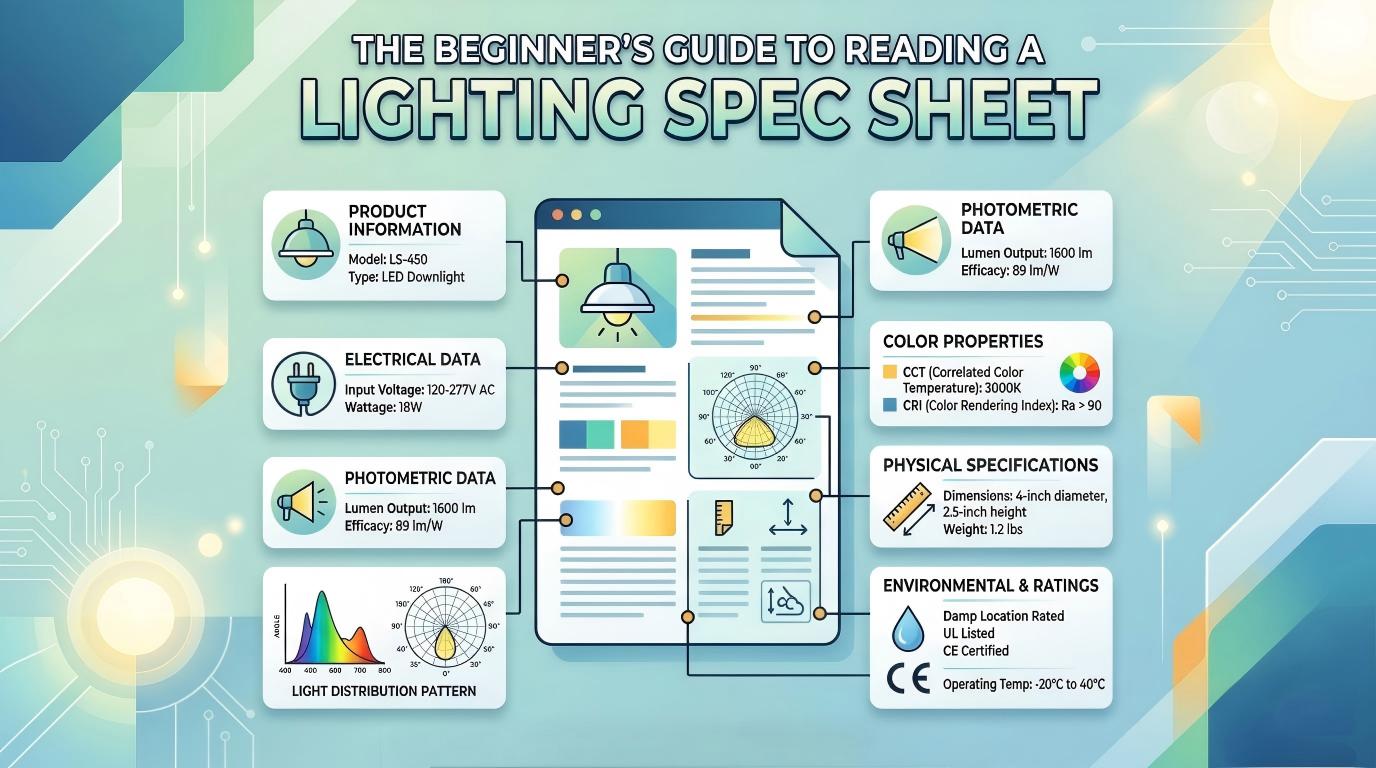
A lighting specification sheet, often referred to as a "spec sheet" or "cut sheet," is a technical document provided by manufacturers that lists the precise physical, electrical and optical characteristics of a lighting fixture or bulb. It serves as a standardised data record detailing essential metrics such as light output (lumens), colour temperature (Kelvin), energy consumption (watts) and physical dimensions. By providing these objective measurements, the specification sheet enables designers, contractors and consumers to verify that a product complies with specific safety codes, performance requirements and aesthetic needs before making a purchase.
The Essential Role of a Lighting Specification Sheet
A lighting specification sheet is a crucial technical document for lighting products. It provides users with comprehensive and accurate product information, ensuring excellent performance and safety across various environments. For manufacturers, users, and the industry as a whole, the specification sheet plays a vital role in several key areas, including:
- Clarifying Product Parameters
The specification sheet lists the product’s key technical parameters, such as rated voltage, power, current, luminous flux, color temperature, beam angle, protection rating, dimensions, and more. By providing these details, users can fully understand the product's performance and ensure it meets their specific application needs. This helps users make informed decisions during the selection process and avoid issues caused by mismatched parameters.
- Guiding Installation and Usage
The specification sheet provides detailed instructions for installation and usage, including installation requirements, wiring methods, and applicable environments. These details help ensure the proper and safe installation of the lighting fixture, preventing safety hazards or performance issues that could arise from incorrect installation. Clear usage instructions also enable users to maximize the fixture’s functionality in various settings.
- Ensuring Safety and Compliance
Typically, the specification sheet will include safety indicators such as electrical shock protection rating, flame retardant rating, and operating temperature range. These safety features ensure the lighting product complies with relevant safety standards and regulations, minimizing the risk during use. For users, these safeguards are crucial in determining whether the fixture can operate safely.
- Supporting Maintenance and Repairs
To facilitate the long-term use and maintenance of lighting fixtures, the specification sheet also includes information on the product’s structure, vulnerable components, and maintenance recommendations. This allows users or technicians to quickly diagnose any issues and take appropriate corrective action. Not only does this extend the lifespan of the fixture, but it also helps reduce maintenance costs over time.
- Promoting Communication and Collaboration
The specification sheet serves as an essential communication tool between manufacturers, users, designers, and engineers. It ensures that all parties have a clear and unified understanding of the product’s specifications, technical requirements, and application scenarios. This minimizes misunderstandings and disputes arising from information discrepancies. Accurate specifications are crucial in collaborative projects, as they help everyone involved align their expectations and goals.
- Assisting with Certification and Compliance
The specification sheet is also a vital document for obtaining various certifications, such as CE, UL and ETL. It proves that the lighting product meets the necessary standards and regulations, which is vital for accessing the market. For manufacturers, a well-documented specification sheet can enhance a product's competitiveness in the market and facilitate the expansion of sales channels.
The Most Important Parts of a Lighting Spec Sheet
These five parameters appear on every spec sheet, regardless of fixture type. Get comfortable with them and you'll be able to evaluate almost any lighting product confidently.
- Lumen Output
For decades, people bought light bulbs based on wattage — a 60W bulb, a 100W bulb. But wattage measures energy consumption, not brightness. With the rise of LED technology, a 10W LED can easily outshine a 60W incandescent. The number you actually need is lumens.
Lumens measure the total amount of visible light a fixture produces. A cozy bedside lamp might sit around 400–600lm. A kitchen work surface needs 800–1200lm. A large open-plan living area could require 3,000lm or more across multiple fixtures.
Match lumen output to the room's function, not just its size. A warm, low-lumen reading nook feels intentional; the same output in a bathroom feels dim and impractical. If the spec sheet lists both "LED lumens" and "delivered lumens," always use the delivered figure — it accounts for real-world losses through the fixture housing and optics.
2. Color Temperature (CCT)
Color temperature is measured in Kelvin (K) and describes the tone of the light — from the deep amber warmth of candlelight to the crisp blue-white of a cloudy sky. It's one of the single most powerful factors in how a room feels, yet it's also one of the most frequently overlooked at the point of purchase.
| CCT | Description | Typical Applications | Key Characteristics |
|---|---|---|---|
| 2700K–3000K | Warm White | Living rooms, bedrooms, hospitality spaces | Flattering on skin, calming atmosphere |
| 3500K–4000K | Neutral White | Kitchens, bathrooms, home offices | Clean, focused, not too clinical |
| 5000K+ | Daylight | Garages, studios, task-heavy spaces | High visual accuracy, less ambient |
Be consistent. Mixing a 2700K pendant with 4000K downlights in the same room creates a visual dissonance that's hard to name but immediately uncomfortable to live with. Check the CCT on your spec sheet and match it across every fixture in the space.
3. Color Rendering Index (CRI)
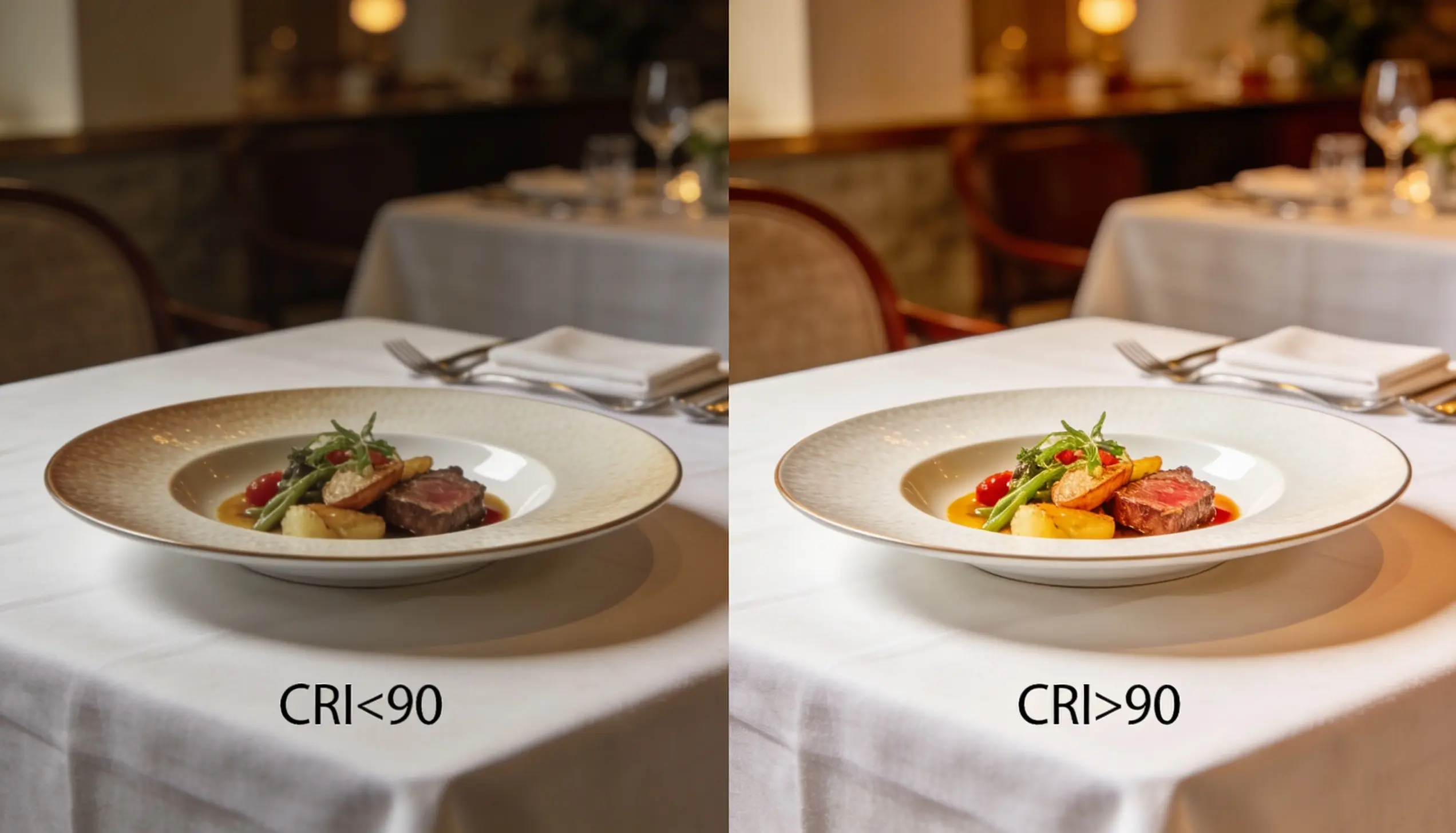
CRI measures how accurately a light source reveals the true colors of the objects it illuminates, on a scale of 0 to 100, where 100 is natural sunlight. A low-CRI light can make warm terracotta walls look muddy, rich navy fabrics appear almost grey, and skin tones look flat or unflattering.
For residential use, CRI 90+ is the benchmark worth aiming for. It means colors look rich, accurate, and alive — the way they looked when you chose them. CRI 80–89 is acceptable for utility spaces. Anything below 80 tends to feel noticeably off in spaces where aesthetics matter.
4. Dimming Compatibility
This is the most common source of post-purchase frustration in residential lighting. A fixture flickers at low levels, buzzes when dimmed, or refuses to go below 30% brightness — not because it's defective, but because it's incompatible with the dimmer switch already installed in your home.
Spec sheets will typically list the dimming protocol supported: TRIAC/leading edge (the most common household dimmer type), trailing edge (smoother, quieter, preferred for LEDs), or 0–10V (a commercial standard). Some fixtures list specific compatible dimmer models by brand — this is incredibly useful information that most buyers never read.
5. Rated Lifespan & Warranty
What does "50,000 hours" actually mean? Almost every LED product advertises an impressive lifespan — 30,000 hours, 50,000 hours, sometimes more. But there's a crucial detail buried in the spec sheet that changes how you should interpret those numbers: L70.
L70 is the point at which a fixture's light output has degraded to 70% of its original brightness. So "50,000 hours L70" means the light will still be working after 50,000 hours, but it will only be producing 70% of the lumens it started with. That's very different from claiming it will feel as bright as day one. A separate — and equally important — figure is the warranty term, which reflects the manufacturer's actual confidence in the product. A 5-year warranty from a reputable brand is a meaningful commitment. A 1-year warranty on an expensive fixture is a quiet warning sign.
How to Read a Lighting Spec Sheet Step by Step
Reading a lighting spec sheet for the first time can feel like looking at a math exam. To make it easy, follow this 4-step approach. Instead of reading every single number, look for these specific details first.
Step 1: Dimensions & Mounting
Before you care about the light, you need to know if the fixture actually fits your space.
- Dimensions: Look for a technical drawing. Check the Length, Width, and Height/Depth. (Crucial for recessed lights going into shallow ceilings!)
- Mounting Type: Does it say Recessed (inside the ceiling), Surface Mounted (on the ceiling), or Pendant (hanging)?
- Cut-out Size: If it’s a downlight, look for the "Cut-out" diameter. This is the actual hole you need to saw.
Step 2: Light Performance
This tells you how the room will actually look. Look for these three specific terms:
- Lumens (lm): This is the Brightness. Ignore Wattage for brightness; look for Lumens. (Example: 800lm is roughly a standard 60W bulb).
- CCT (Color Temperature): Measured in Kelvin (K). 2700K - 3000K: Warm/Yellow (Cozy, Bedrooms). 4000K: Neutral/White (Clean, Kitchens/Offices). 5000K+: Cool/Blue (Daylight, Garages).
- CRI (Color Rendering Index): How "real" colors look. Look for CRI 90+ if you want your food, clothes, or art to look vibrant.
Step 3: Power & Control
This is for your electrician to ensure nothing blows a fuse or flickers.
- Input Voltage: Usually 120V (North America) or 220-240V (Europe/Asia). Make sure it matches your wall power.
- Wattage (W): How much electricity it pulls. Lower is better for your bill.
- Dimming: Look for "Dimmable: Yes/No." Also, check the protocol (e.g., TRIAC, 0-10V, or DALI). Your dimmer switch must match this type!
Step 4: Durability
Where can this light live safely?
- IP Rating: This tells you about water/dust protection.
- IP20: Dry indoor areas only.
- IP44/IP54: Splash-proof (Bathrooms).
- IP65+: Jet-proof/Rain-proof (Outdoors).
- Lifespan (L70): Usually listed in hours (e.g., 50,000 hrs). This tells you how long the light lasts before it loses 30% of its original brightness.
A Good Spec Sheet Is a Brand's Promise to You
Reputable lighting brands don't hide behind vague product descriptions. They publish complete, honest specification sheets — because they stand behind what's in them. If you ever find yourself looking at a product with missing or incomplete specs, that absence tells you something important about the manufacturer.
At UPSHINE Lighting, we've spent years engineering LED solutions for commercial, residential, and architectural spaces, and every product we've ever made comes with a complete, fully transparent specification sheet. Just honest numbers that tell you exactly what you're getting before you commit to a single fixture.
We believe that a spec sheet is more than just a technical document. It reflects how seriously a manufacturer takes their craft and their customers. We hold ourselves to this standard across every downlight, linear system and other fixture in our range.
Ready to find the right light for your space? Every product in our range comes with a full, transparent specification sheet — because we believe you deserve to know exactly what you're buying.