





When flying at night, you may have noticed the flashing lights lining the airport runway or the brightly lit terminals. These seemingly simple lighting systems are, in fact, a critical component of modern aviation safety. Whether during nighttime operations or in low-visibility conditions such as heavy fog or rain, airport lighting provides pilots with precise guidance for takeoff and landing, ensuring aircraft operate safely. At the same time, illuminated terminals enhance visibility for ground operations, supporting the smooth and efficient movement of passengers. This article explores the essential "lighting safeguards" installed throughout airports and examines how they contribute to the safety and reliability of every flight.
- Key Roles of Airport Lighting
- Common Types of Airport Interior Lighting
- Categories of Airport Outdoor Lighting
- Innovations in Airport Lighting: LED vs. Traditional Systems
- How Airport Lighting Systems Adapt to Weather Conditions?
- Emergency Airport Lighting for Safety
- Upcoming Developments in Airport Lighting
- Conclusion
Key Roles of Airport Lighting
Airport lighting plays a crucial role in modern aviation, functioning as a key element in various scenarios to ensure smooth and safe airport operations.
- Provide Help for Passengers
A good lighting system in the terminal can effectively guide passengers' passage. A reasonable layout and brightness design of the lights can highlight signs, service facilities, and emergency exits, reducing the chances of passengers getting lost or staying in one place. Meanwhile, the lighting should be designed differently according to the functions of different areas. For example, soft lighting should be used in the waiting area to create a comfortable atmosphere and relieve passengers' fatigue while waiting.
- Ensure Flight Safety
The primary task of airport lighting is to ensure flight safety. By providing clear runway, taxiway and apron lighting systems, it effectively guides pilots to accurately complete takeoff and landing operations at night or in low visibility conditions, preventing them from entering non-operational areas or deviating from critical flight paths.
- Guide Ground Operations
Airport ground staff, like pilots, rely heavily on lighting systems. A scientifically and rationally designed lighting layout helps staff clearly identify the movement of aircraft, vehicles and personnel, thereby effectively preventing potential safety accidents and ensuring the safe and efficient operation of ground operations.
- Enhance Airport Visibility
Airport lighting can significantly enhance environmental visibility at night or in bad weather conditions, ensuring operational safety and efficiency. Scientific and reasonable lighting design can improve the convenience and overall sense of security for staff operations, creating a more comfortable and efficient travel experience.
- Emergency Lighting Function
In emergency situations, the airport lighting system can provide reliable emergency lighting to ensure that people can quickly and safely find the evacuation routes. The layout of emergency lights, both inside and outside the airport, is particularly crucial, especially in special circumstances such as power outages or sudden accidents, which can effectively guide people to evacuate in an orderly manner and maximize the protection of life safety.
- Energy Conservation & Environmental Protection
With increasingly strict environmental protection requirements, more and more airports are beginning to adopt energy-efficient equipment such as LED lighting. Such technologies not only significantly reduce energy consumption but also effectively cut carbon emissions, thus promoting the green transformation of the civil aviation industry and aligning with the long-term goal of sustainable development.
Common Types of Airport Interior Lighting
The interior lighting design of airport terminals is usually highly professional, which stems from their complex functional requirements and special usage environments. To meet the lighting needs of different areas, various types of professional lighting fixtures are typically selected, such as LED downlights and LED panel lights. These lighting fixtures can not only provide efficient illumination but also enhance the passengers' experience, ensure safety, and adapt to the specific needs of various functional areas. The following text will systematically introduce several common types of airport interior lighting fixtures and their application scenarios.
- LED Downlights
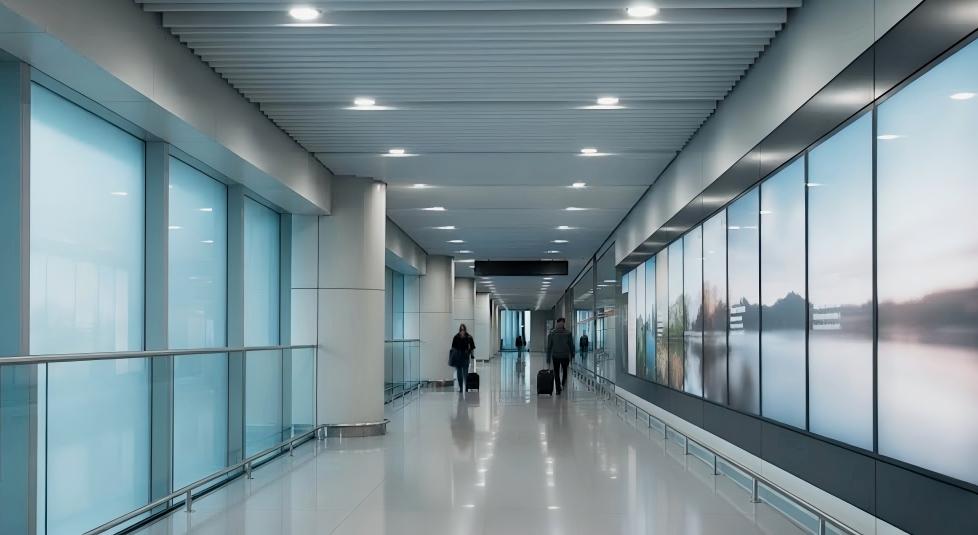
LED downlights are the core lighting equipment in the lighting systems of modern airport terminals, playing an irreplaceable role in various key functional areas. They are widely used in common areas such as the central hall, main corridors, security checkpoints, and waiting areas, undertaking the important task of providing efficient and stable main lighting. Their excellent luminous efficacy, energy-saving features, and long service life make them the preferred option in airport interior lighting design.
- LED Panel Lights
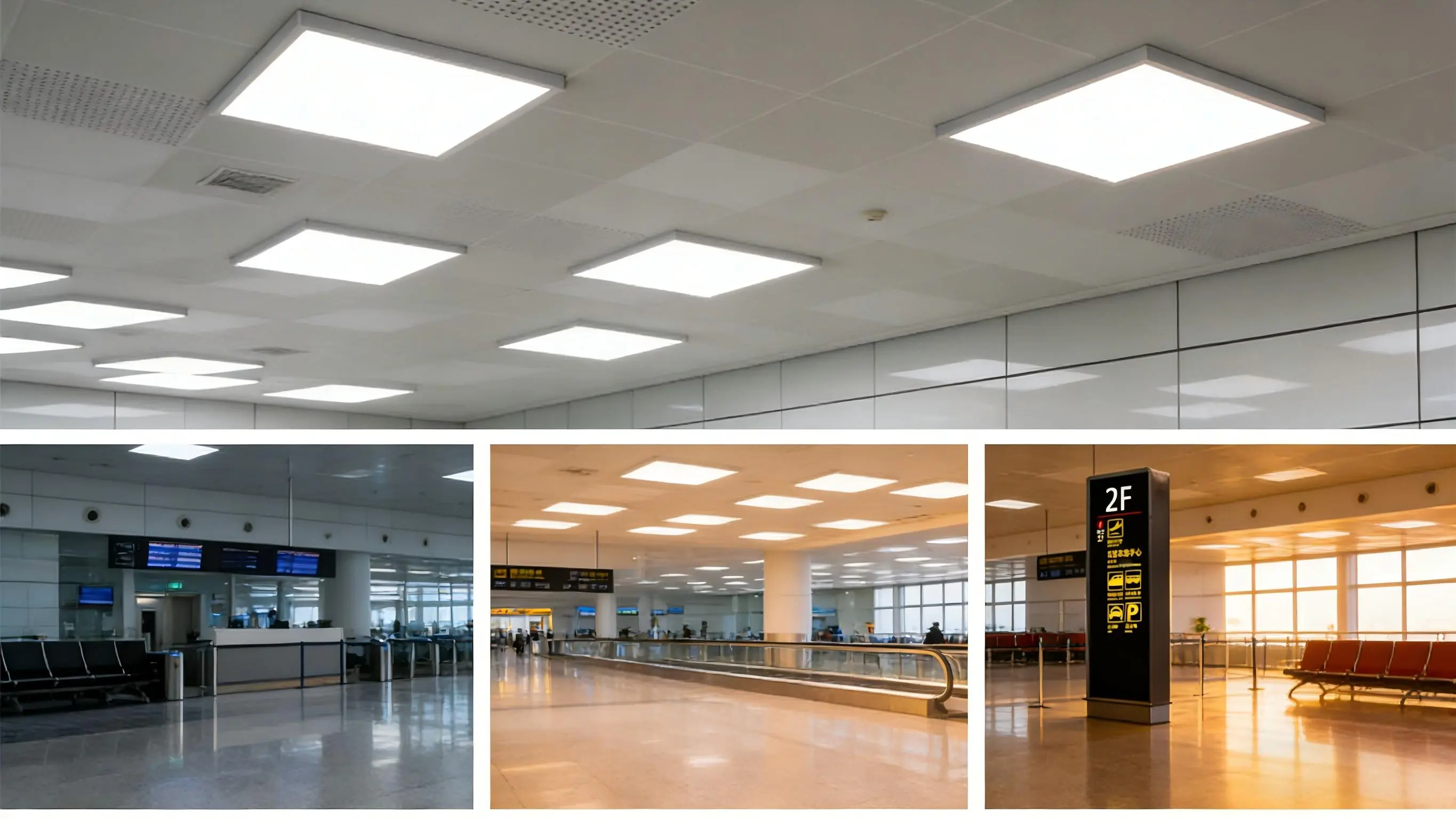
LED panel lights deliver uniform and soft illumination, creating a comfortable visual environment. With their sleek, ultra-thin design, they not only provide ample lighting but also save space and preserve the clean, minimalist aesthetic of ceilings. These lights can serve as the primary light source or be combined with downlights and other fixtures to enhance overall brightness. Commonly installed in public spaces such as airport lounges, waiting areas, and corridors, they offer both functional efficiency and visual appeal.
- LED Linear Lights
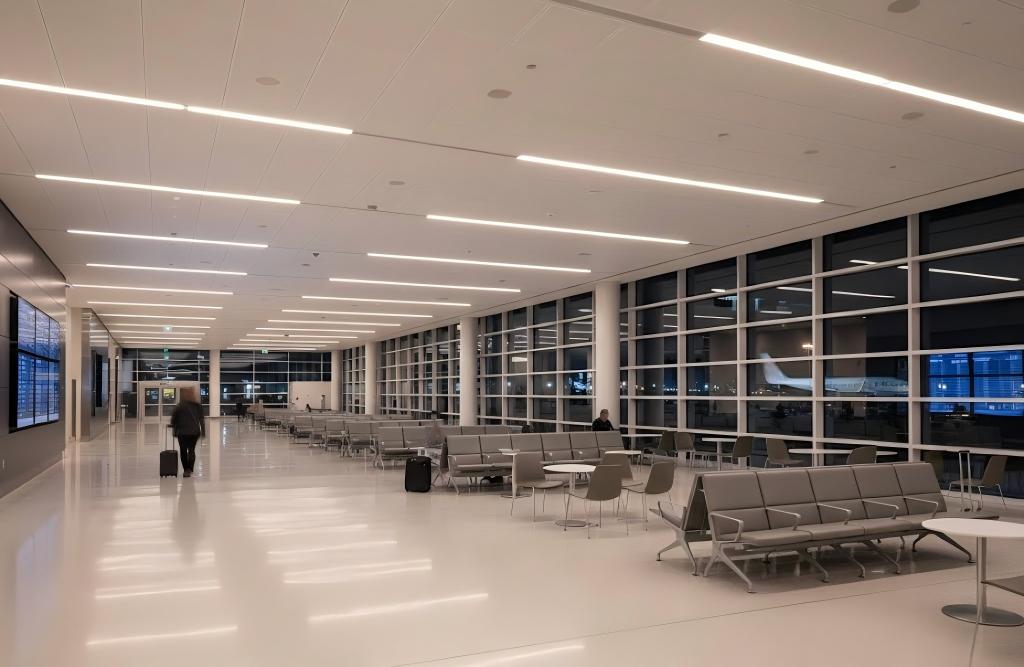
LED linear lights are widely used in airport lighting systems due to their high energy efficiency and flexibility. In large spaces such as the check-in hall and waiting area of the terminal building, they can be installed in an embedded or ceiling-mounted way to provide uniform and soft basic lighting, creating a comfortable and pleasant lighting environment. In long and narrow spaces, such as corridors, LED linear lights can outline the spatial contour through a continuous arrangement, enhancing the guiding function and the sense of spatial hierarchy, and improving the modern and high-end feel of the overall space.
- LED Floodlights
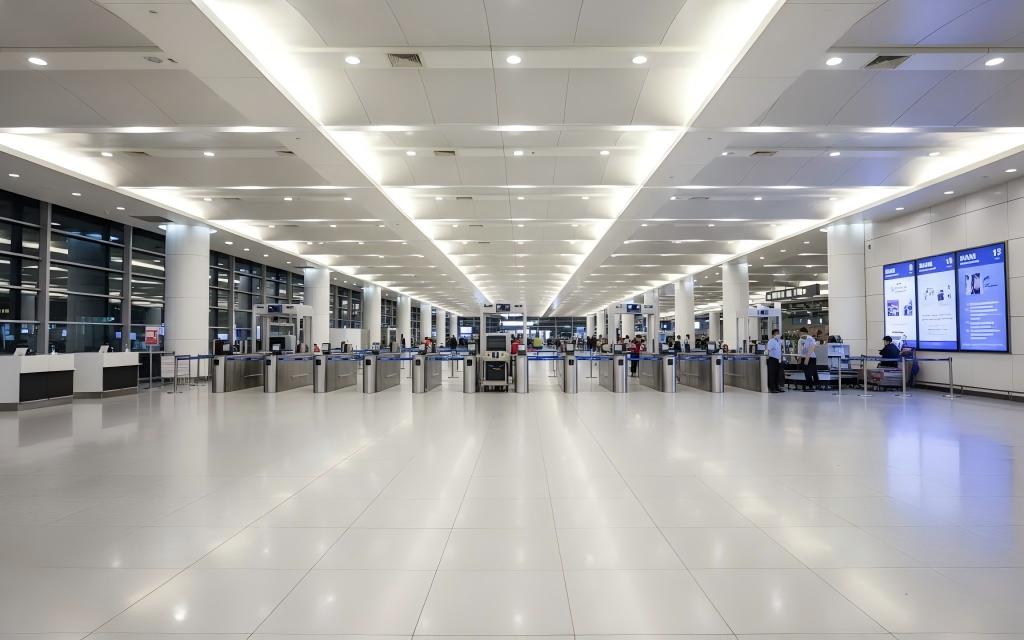
LED floodlights are also widely used in airport terminals. In the lighting design of airport terminals, high-power LED floodlights are usually installed on the ceiling or the top of the building structure, and the space lighting is achieved by reflecting light off the ceiling surface, which is conducive to achieving indirect lighting and mixed lighting effects in the space.
- LED Strip Lights
LED strip lights are flexible decorative lighting solutions that integrate LED sources into a linear design. Their discreet and adaptable installation makes them ideal for creating layered ambient lighting in airports. For instance, embedding them into ceiling structures in business lounges enhances spatial cohesion and visual comfort. When paired with LED downlights, they contribute to an energy-efficient, high-performance lighting system.

Categories of Airport Outdoor Lighting
Airport outdoor lighting systems are typically classified into several categories based on their different functions and applications. Next, we will introduce in detail several main classifications of airport outdoor lighting to help you better understand the unique functions of each type of light.
- Runway Lights
- Runway Edge Lights
Runway edge lights are essential lighting systems installed along both sides of an airport runway to define its boundaries. They play a critical role in helping pilots accurately identify the runway’s position and orientation during nighttime or low-visibility conditions. Typically installed at regular intervals, these lights emit white light along most of the runway, transitioning to yellow in the final 2,000 feet and red at the end to signal proximity to the runway termination.
2. Runway End Lights
Runway end lights are installed at the far end of the runway to clearly indicate its termination point. These lights must be unidirectional, emitting a steady red light towards the runway. The intensity and beam spread angle should be carefully calibrated according to operational requirements under varying visibility levels and ambient lighting conditions, ensuring pilots can reliably identify the runway end in all flight scenarios.
3. Runway Centerline Lights
Runway centerline lights are precisely installed along the centerline of the runway to provide pilots with accurate visual guidance during low-visibility landings. These lights are typically spaced at 50-foot intervals, with exact configurations tailored to the airport’s operational category and runway length. Starting from the runway threshold, the first 3,000 feet feature white lights, followed by 2,000 feet of alternating red and white lights, and the final 1,000 feet consist entirely of red lights. This progressive color transition effectively alerts pilots as they approach the runway end.

- Taxiway Lights
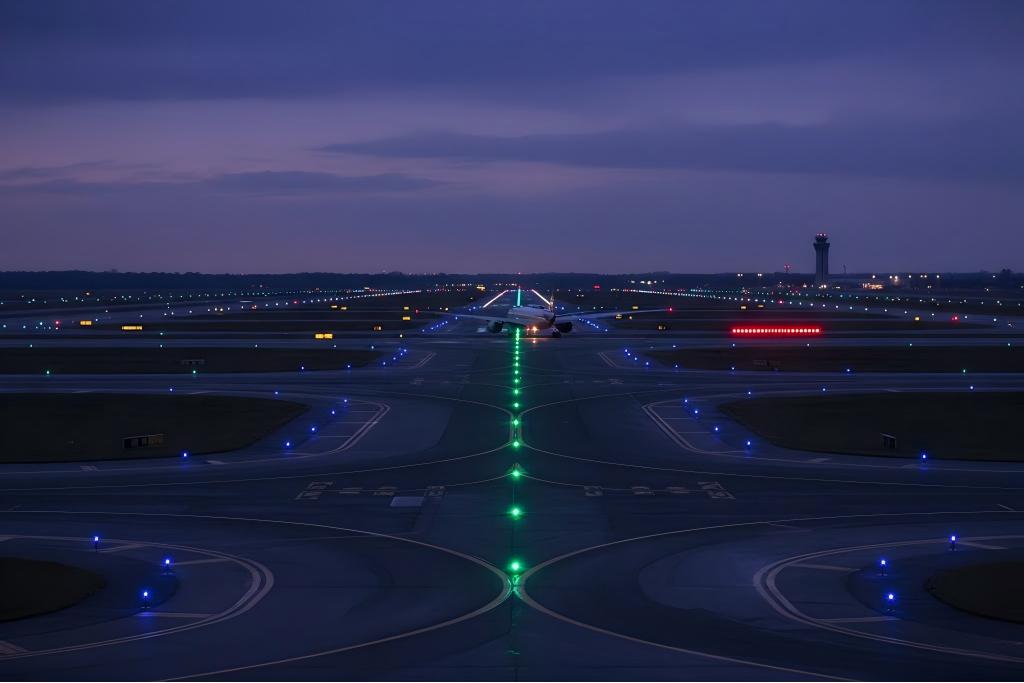
Taxiway lights are installed on the taxiways and aprons of airports, emitting blue light. They are mainly used to guide flight crews and ground vehicles to travel along the correct route under night or low visibility conditions. The illumination intensity of taxiway lights is relatively low, and their main function is to mark the taxiing path, ensuring that aircraft can safely travel from the terminal building or hangar area to the runway, or return from the runway to the parking area. As an important part of the airport ground lighting system, taxiway lights play a crucial role in ensuring the safety and efficiency of aircraft ground operations.
- Approach Lights
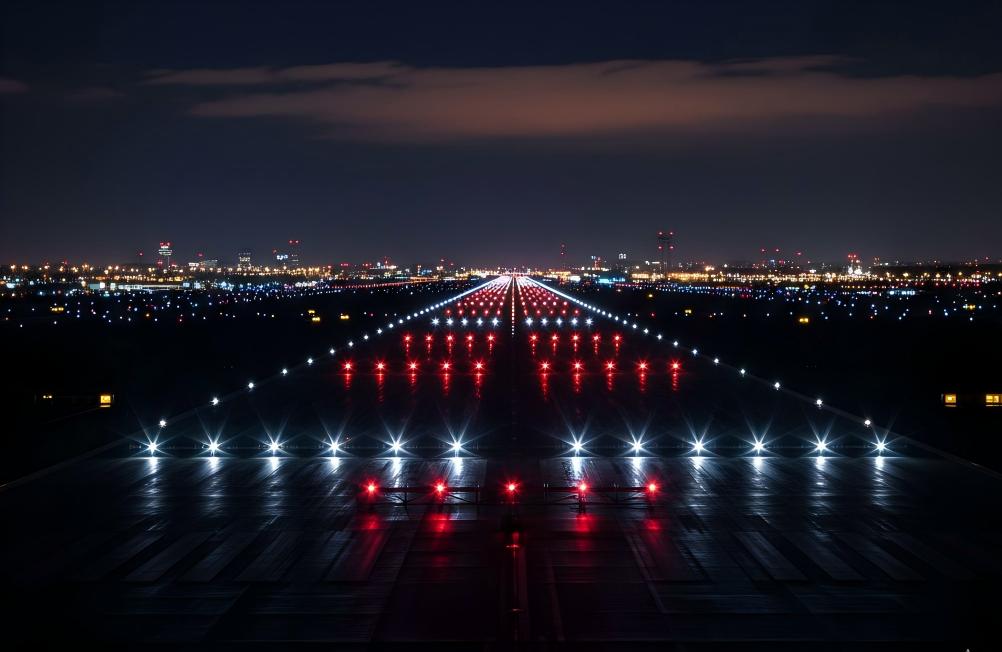
Approach lights are installed at the approach end of the runway and consist of a series of transverse rows of lights, flashing lights, or a combination of both, extending from the runway entrance to the approach area. There are various types. Under conditions of low visibility or bad weather, approach lights are usually identified by pilots visually earlier than the runway, providing crucial guidance information to help pilots smoothly complete the transition from instrument flight to visual flight during the landing phase.
Innovations in Airport Lighting: LED vs. Traditional Systems
Currently, LED lighting systems are extensively utilized in airports due to the technology’s notable advantages in energy efficiency, longevity, reliability, and reduced maintenance costs.
First, LED lighting offers significantly higher energy efficiency compared to traditional lighting technologies such as high-pressure sodium and halogen lamps. It delivers equivalent or superior illumination while drastically reducing energy consumption, enabling airports to meet energy-saving and emission-reduction targets. This aligns with the broader goals of modern green infrastructure development.
Secondly, LED lamps typically have a service life ranging from 50,000 to 100,000 hours, significantly longer than the few thousand to 20,000 hours offered by traditional lighting solutions. This extended lifespan makes LEDs particularly advantageous in environments requiring continuous operation, such as airports, where frequent lamp replacements can be both costly and disruptive. By reducing the need for maintenance, LED lighting lowers operational workloads and decreases the likelihood of service interruptions. Critical areas, including runways, taxiways, aprons, and terminal perimeters, demand highly reliable illumination due to stringent safety requirements. The robust performance of LEDs ensures consistent operation even under extreme weather conditions such as heavy rain, snow, strong winds, and subzero temperatures.
Thirdly, LED lighting offers superior optical control, enabling precise light distribution that minimizes light pollution and glare. This enhanced clarity significantly improves pilots’ visual recognition during critical phases of flight such as takeoff and landing, thereby boosting flight safety. Moreover, many LED systems are equipped with intelligent controls, allowing dynamic adjustments to brightness, color temperature, and scheduling according to operational requirements. These capabilities not only optimize lighting performance but also enhance energy efficiency.
Overall, LED lighting significantly improves the quality and safety of airport illumination while substantially reducing long-term operational costs, making it the preferred choice for modern airport lighting systems. As technology continues to advance, the application of LEDs in airports is expected to expand further, such as through integration with Internet of Things (IoT) systems to enable remote monitoring and early fault detection, thereby accelerating the development of smart airports.
How Airport Lighting Systems Adapt to Weather Conditions?
Under adverse weather conditions such as rain, snow, fog, or strong winds, airport lighting systems often face challenges, including reduced light penetration, lower visibility, and an increased risk of equipment malfunction. To address these issues, modern systems have increasingly integrated intelligent technologies capable of automatically adjusting brightness, light distribution, and even color based on real-time meteorological data. For instance, during periods of low visibility, the system can increase the intensity of runway lights to maximize visibility, enabling pilots to identify ground guidance cues earlier and more reliably.

Emergency Airport Lighting for Safety
Emergency airport lighting refers to the illumination activated when the primary power supply fails, playing a critical role in ensuring flight safety. Under normal conditions, airports depend on a comprehensive lighting system to provide clear visual guidance for take-offs, landings, taxiing, and ground operations. However, during emergencies, such as power outages, severe weather, equipment failure, or nighttime emergency landings, the emergency lighting system becomes an essential component of aviation safety infrastructure.
Upcoming Developments in Airport Lighting
- Continuous LED Performance Upgrades
Technologies such as LED chips and heat dissipation will continue to be optimized, leading to a further increase in luminous efficacy and a decrease in cost. As a result, LEDs will be more widely applied in a greater variety of scenarios at airports.
- Deepening Smart Integration
With the advancement of technology, airport lighting systems will become more intelligent in the future. By adopting LED technology and the Internet of Things (IoT) technology, they can achieve automatic adjustment, remote monitoring, and real-time response, thereby enhancing safety and efficiency. For example, the intelligent sensing system can automatically adjust the light intensity according to the ambient light or weather changes.
- Emphasis on Green Sustainability
Driven by the concept of sustainable development, the design of airport lighting systems is advancing towards a more environmentally-friendly direction, with the widespread use of recyclable materials and green energy. Technologies such as solar-powered LED lighting and natural light collection systems will be gradually popularized. Meanwhile, bird-friendly lighting designs will also be more widely applied, effectively reducing carbon emissions and significantly lowering the risk of bird strikes at the same time.
Conclusion
Airport lighting is not only an important means to enhance visual effects but also a crucial part in ensuring aviation safety. With the continuous advancement of technology, the future airport lighting systems will accelerate their development towards the direction of intelligence and automation. Every fixture in each area of the airport has its unique function and irreplaceable value, silently safeguarding the safe travel of every passenger.